Sunday, 24 May 2015

Michael Michaud


As part of the Botanics unit I looked at some of the work of Michael Michaud. I particularly liked the herb, fruit and veg collections.


The Michael Michaud Jewellery Collection, designed by Michael Michaud, is a world renowned collection of botanical jewellery. It captures the beauty and exquisite detail of nature using soft patinas on bronze accented with pearls, beads, coral and stones. His exacting attention to detail gives you true to nature, botanical jewellery.
 
This unique jewellery is made by creating moulds directly from botanical elements in a process similar to lost-wax casting. While traditional lost-wax casting begins with a hand-carved model of wax, Michael Michaud instead uses an actual leaf, branch or flower in place of the wax model. A mould is created around the botanical element and as it is heated the plant matter burns away and leaves behind a beautifully detailed mould of itself.
 
Michael Michaud Jewellery is renowned for its beauty and workmanship and is featured in the finest museums,  galleries and speciality retailers around the world. Many collections are commissioned by leading museums such as The Victoria & Albert Museum, The Art Institute of Chicago, The National Gallery of Art and the Château de Versailles.
 
Artist Michael Michaud attended the Rochester Institute of Technology's prestigious school for American craftsmen, where he studied under designers Hans Christenson and Gary Griffin and became a master in the creation and manipulation of moulds. After graduating in 1980, Michael Michaud continued to perfect his craft while working under jewellery designers in the New York City area. In 1991, he found himself working in New York City's flower district and living in the beautiful Connecticut countryside - his love of the natural beauty that surrounded him began to blend with his passion for creating jewellery which lead to the birth of Michael Michaud Jewellery.
 
Each piece of Michael Michaud Jewellery is handcrafted  in New York, U.S.A.

Pea Pod Bracelet

Pea Pod Earrings
 
Blueberry Earrings

Raspberry Earrings

Cranberry Bracelet
 
Rosemary Earrings
 
Rosemary Spray Collar Necklace

Sage Earrings

Sage Necklace

Thyme Necklace
 
I also like the flower and tree collections ...
 
Hydrangea Cuff Bracelet
 
Hydrangea Earrings
 
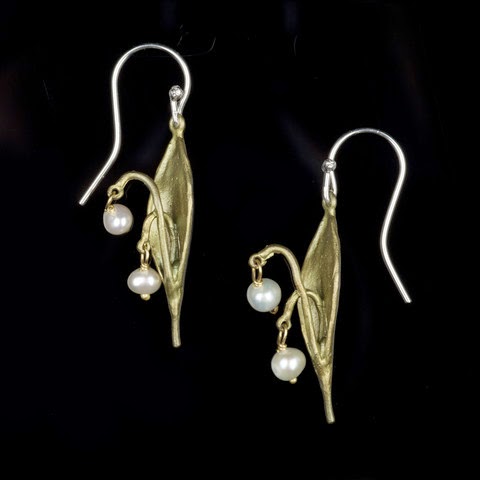
Lily of the Valley Earrings

Pussy Willow Necklace

Charm Necklace

Charm Bracelet

Acorn Earrings
 
 
I found Michaud's work fascinating and there is definitely a lot of attention to detail. The items are so realistic that the viewer may think they are looking at the real thing. I would love to be able to learn more about this technique.


Colette Hazelwood


Colette Hazelwood is a contemporary jewellery designer based in Manchester who has been creating hand made unique jewellery professionally since 2000. She incorporates both precious and non-precious materials in her work and she is a leading jeweller within her field. Her international reputation is one of innovation and originality.

She uses a variety of techniques and works mainly in silver although she is flexible in the material she uses.  She welcomes commissions and has exhibited worldwide.  All her jewellery is unique and she has different ranges including wraparound, coil bangles, message bangles, flowers and barbed wire.  Within each range she can produce necklaces, bracelets and ear rings to produce matching sets.  She also produces several items for men to wear including cuff links, bangles and necklaces/pendants.

flat triple bangle range

teardrop bangle range

flower range

wraparound range

coil bangle range

message range
 
I'm particularly interested in the flower collection as it uses real flower petals, then dries and laminates them to keep them looking fresh. I will experiment with this technique in my Botanics unit.
I also like the wraparound range as it makes a complicated design with fairly simple materials and techniques of wrapping the wire around a rod.


Wednesday, 20 May 2015

She sells Sea Shells by the Skyline...

This unit involved drawing and photographing buildings; life drawing, and still life miniatures and an A1 sized piece of work taken from the miniatures we did in our sketchbooks.

I used acrylic, watercolour and coloured pencils to create this piece of work and I was very pleased with the final result. The hardest bit was trying to give the impression of the rounded part of the shell which I tried to do by using curved lines.


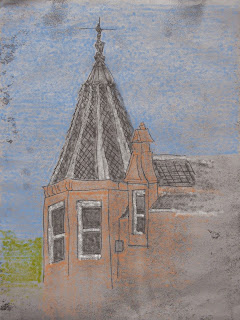
For the architectural part of the unit, I used a bridge near the college, the cinema and a couple of close ups of tower/turret buildings around Galashiels. I find drawing buildings difficult because of the straight lines and getting the perspective right. However, overall I'm pleased with most of the finished results. I particularly enjoyed drawing the bridge and the simple landscape in the background.


We then did about four life drawing sessions each 3 1/2 hours long. This was one of the hardest parts of this unit because we had to get proportion, shapes, shadows etc. right otherwise the model looked disfigured. Needless to say I found this hard and to be honest did not enjoy it at all. However there are one or two results which I am pleased with. Here are a few:


My favourite part of this unit was the still life drawing because we could choose which objects we wanted to draw - I chose shells and some wooden objects we had at home. I particularly liked experimenting with the different media e.g. pencil, pen, ink, coloured pencils, and Inktense pencils. Some people have commented on how effective the shadows are and how realistic the shells look.


Assemblage was another part of this unit and it was interesting learning about artists who use this technique for their work. I looked at the work of Ben Nicholson, Louise Nevelson, Jean Arp, Picasso and Georges Braque.

I tried to incorporate Nevelson's and Arp's use of overlapping items and use of shadows in my work.
White Relief
Ben Nicholson
 
Louise Nevelson

Texte hébraïque
Jean Arp

Still Life with Chair Caning
Picasso
 
Verre Violon et Papier Musique
Georges Braque

I think my assemblage worked  well because the sand I used for the background made it feel like a close up of a small area of a beach. I really like this effect and I think the shells and stick worked well too. I used different sizes and shades of sticks to create the stick in the image - I think it worked well because the shadows made by the small sticks create shadows on the big stick. I also used papier-mâché to make the bigger shell and then painted it using acrylic. I then made the smaller shell by using wire to make a frame and covering it in tissue paper to create the different shades within the yellow and purple. I thought the colours were too bright so I used white tissue paper to make the colours slightly less vivid.


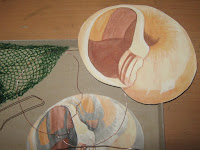
I also did another assemblage in a tray-type frame. This was also fun to do because I used coloured photocopies of my drawings, wire outlines and netting to give the piece an extra beach-y feel. I used sand on the background again because it worked so well on the first one.


The highlights of this unit for me were the assemblages, working with the different objects and materials in particular the wire, papier-mâché and netting. I am looking forward to experimenting further with this technique.